RENMIN UNIVERSITY of CHINA





From Sept 13 to 17, Ma Huaide, President of Renmin University of China (RUC), led a delegation on a visit to Peru and Costa Rica. The delegation visited Universidad del Pacífico, the Pontifical Catholic University of Peru, the National University of San Marcos, the University of Costa Rica, the Central American Institute of Public Administration, the Latin American Faculty of Social Sciences (FLACSO), and the University for Peace. It also attended the Third China-Latin American and Caribbean States Roundtable on Human Rights and visited the Chinese embassies in Peru and Costa Rica.
The visit focused on human rights governance, talent development, joint research, mutual learning among civilizations, area studies and global governance.
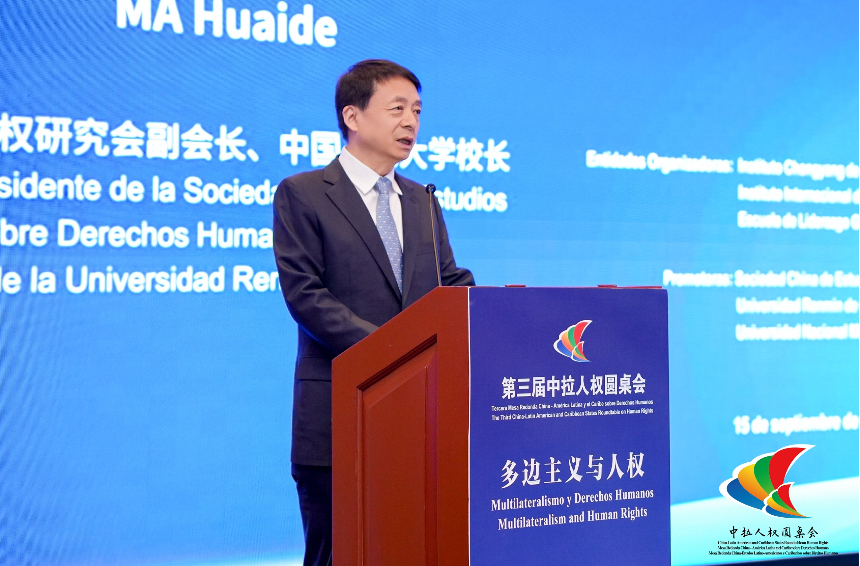
On Sept 15 local time, the delegation attended the Third China-Latin American and Caribbean States Roundtable on Human Rights in Lima, Peru. Themed “Multilateralism and Human Rights”, the event was co-hosted by the China Society for Human Rights Studies, RUC, and the National University of San Marcos, and organized by the Chongyang Institute for Financial Studies of RUC, the Instituto Peruano de Estudios de Política Internacional, and the School of Global Leadership of RUC.
Nearly 200 government officials, scholars, representatives of civil society organizations and think tanks from 24 countries and regions attended the event. Ma delivered remarks at the opening ceremony.
Ma said that upholding genuine multilateralism and reforming and improving global human rights governance have become common aspirations among developing countries. China and Latin America and the Caribbean are both important forces of the Global South and committed to upholding international fairness and justice. In-depth dialogue on human rights can deepen mutual learning among civilizations and provide an example for developing countries’ participation in global human rights governance. RUC is ready to work with partners to uphold multilateralism, strengthen collaborative research and promote mutual learning among civilizations, share authentic stories of human rights development in developing countries, and work from the shared perspective of the Global South toward a better future for humanity.
During the visit to Peru, the delegation visited Universidad del Pacífico, the Pontifical Catholic University of Peru and the National University of San Marcos, holding discussions on talent development, academic research, faculty and student exchanges, and cooperation in areas of academic strength.

At Universidad del Pacífico, the delegation met with Vice Rector Gustavo Yamada and renewed the memorandum of understanding and student exchange agreement between the two universities. Ma said the renewed agreements would build on existing cooperation while further broadening the partnership, including joint research on China-Latin America and the Caribbean issues, innovative courses and study programs, and international talent development. Yamada expressed hope for continued student exchanges and faculty visits, as well as joint research in areas of shared interest.

At the Pontifical Catholic University of Peru, the delegation met with President Julio del Valle and renewed the academic cooperation memorandum of understanding. Ma expressed hope that the two sides would deepen cooperation in archaeological heritage preservation, joint research drawing on their academic strength and integrated talent development. Del Valle expressed interest in expanding cooperation in climate change, sustainable development and international relations.

At the National University of San Marcos, the delegation met with Rector Jeri Ramón. Ma highlighted the university’s long-standing strengths in law, public administration and other fields in the humanities and social sciences. He expressed hope for joint research, innovative approaches to talent development and deeper mutual learning between the Chinese and Peruvian civilizations. Ramón said the university is willing to expand faculty and student exchanges and explore interdisciplinary cooperation in emerging fields such as information engineering and artificial intelligence. The two sides also exchanged views on cooperation in human rights governance and public administration.

In Costa Rica, the delegation visited the University of Costa Rica and met with Rector Carlos Araya Leandro. Wang Xiaoyao, Chinese Ambassador to Costa Rica, attended the meeting. The two sides renewed their student exchange agreement and discussed supporting the continued development of the Confucius Institute, expanding youth exchanges and deepening cooperation in areas of academic strength.
Ma expressed hope that the two sides would further develop the Confucius Institute, expand two-way student exchanges, strengthen academic cooperation and jointly build platforms for mutual learning between Chinese and Latin American and Caribbean civilizations. He also called for collaborative research on mutual learning among civilizations, China-Latin America and the Caribbean relations, Global South cooperation and area studies. Araya welcomed continued cooperation in research, joint talent development and faculty and student exchanges. Ambassador Wang congratulated the two universities on their long-standing cooperation and the renewal of their agreement and said the embassy would continue to serve as a bridge for cooperation.
The delegation also visited the Confucius Institute at the University of Costa Rica, jointly established by the two universities, for a working meeting and briefing on the institute’s work.
The delegation further visited FLACSO, the Central American Institute of Public Administration and the University for Peace, seeking to expand cooperation in area studies, public governance and global governance.

At FLACSO, the delegation met with Secretary-General Rebeca Lemos. Ma expressed hope that the two sides would promote regional academic cooperation through institutional mechanisms, advance joint knowledge creation between China and Latin America and the Caribbean, and strengthen talent development and exchanges. He also called for joint efforts to enhance the representation and influence of the Global South in international academia and global governance. Lemos expressed interest in deeper academic cooperation with RUC in areas including law and public policy, as well as exploring postdoctoral programs for young Latin American scholars.

At the Central American Institute of Public Administration, the delegation met with President of the Board of Directors Javier Argueta Gómez. Ma called for deeper joint research on regional governance, innovative training programs for public officials from Central America, long-term mechanisms for academic exchanges and cooperation, and greater collaboration in administrative law and regulatory governance. Argueta expressed interest in cooperation on topics such as AI and public services, as well as continued faculty exchanges, joint courses and research.

At the University for Peace, the delegation met with Rector Francisco Rojas Aravena. Ma noted the shared missions and complementary academic strengths of the two universities and expressed hope for regular inter-university cooperation, diversified talent-development programs, high-level academic dialogue, and joint platforms for international organization internships and youth peace initiatives. Rojas welcomed stronger ties with RUC in international law and other fields through student exchanges and joint research, and invited RUC students to study and exchange at the University for Peace.


During the visit, Ma also met separately with Song Yang, Chinese Ambassador to Peru, and Wang Xiaoyao, Chinese Ambassador to Costa Rica. He introduced RUC’s exchanges and cooperation with universities, think tanks and international organizations in Peru, Costa Rica and across Latin America and the Caribbean, and discussed expanding the university’s regional partnership network, advancing key cooperation projects, and strengthening area studies and talent development.
The visit was part of RUC’s efforts to deepen cooperation with Latin America and contribute to China’s broader opening-up. Moving forward, RUC will build on its strengths in the humanities and social sciences to deepen practical cooperation with Latin American universities, think tanks and international organizations, promote mutual learning among civilizations, joint academic research and talent development, and contribute to deepening the comprehensive cooperative partnership between China and Latin America and the Caribbean and building a China-Latin America and the Caribbean community with a shared future.