RENMIN UNIVERSITY of CHINA





The 2025 World Humanoid Robot Games, the inaugural global competition for humanoid robots, concluded successfully on August 17. On August 16, at Beijing's National Speed Skating Oval, the RUC-HuHa Team from Renmin University of China (RUC)'s Gaoling School of Artificial Intelligence and School of Information excelled by winning the silver medal in the "Medicine Dispensing and Packaging Skills" competition.
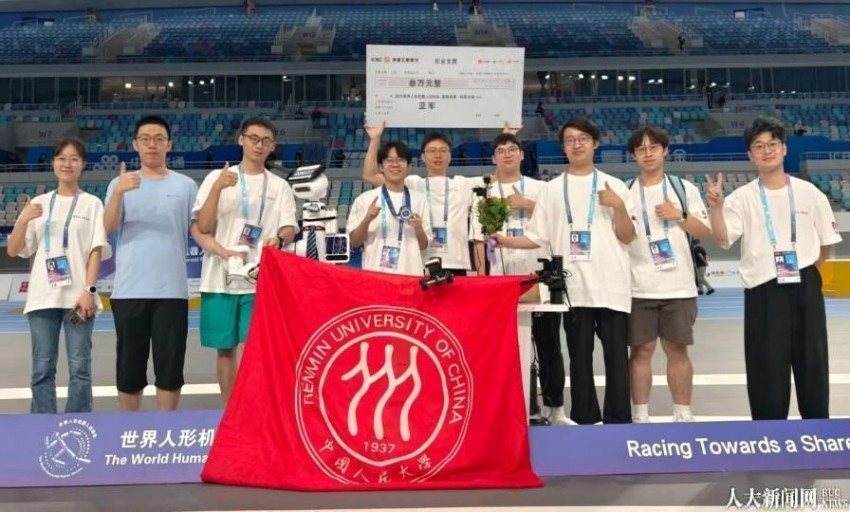
The RUC-HuHa Team wins the silver medal in the "Medicine Dispensing and Packaging Skills" competition during the 2025 World Humanoid Robot Games. [Photo/ruc.edu.cn]
The event gathered 280 teams from 16 countries and regions, including 192 university teams and 88 enterprise teams, with over 500 humanoid robots competing. Across 26 competition categories and 487 matches, the games showcased cutting-edge advances in humanoid robots' intelligent decision-making, motion coordination and real-world adaptability.
Unlike traditional sports competitions, the games introduced a scenario competition unit, featuring four categories: industrial, medical, hospitality, and warehousing scenes. This innovation aimed to test robots' practical capabilities in realistic environments.
The RUC-HuHa Team achieved a total score of 896 points, earning the silver medal and the highest result among university teams in their category.
Formed in early June, the team is composed mainly of undergraduates from freshman to junior years. It is guided by Hu Di, associate professor at the Gaoling School of Artificial Intelligence, and Zhang Jing, professor at the School of Information, with technical guidance from Xia Wenke, a 2022 direct-entry doctoral student at the Gaoling School. Together, they have provided technical oversight, strategic direction, and project experience, helping to bridge the gap in the students' hands-on competition experience.
To achieve efficient and rapid technological iteration, the team organized into three subgroups, namely algorithm iteration, simulation verification, and hardware & data support, working collaboratively to develop their solutions.
Zhou Yutian, a team member, noted that large-scale competition venues present unique challenges. Complex environments and wireless interference from routers, media equipment, and spectators' devices often disrupted communication. In some cases, robots could not operate at all.
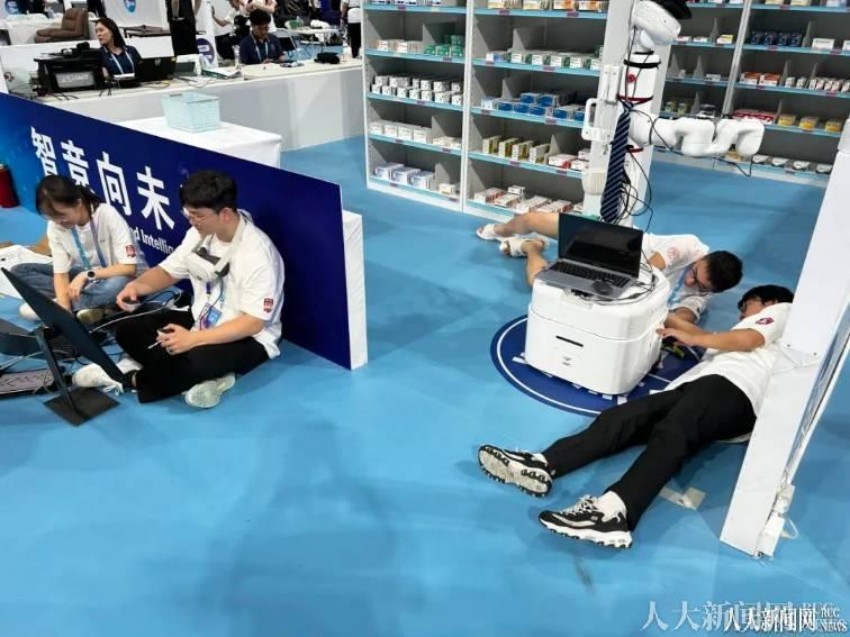
The RUC-HuHa team members adjust equipment on site. [Photo/ruc.edu.cn]
In response, the team adopted innovative algorithms, ensured stable mechanical performance, and optimized scenario adaptability. These efforts enabled the team to stand out among strong competitors.
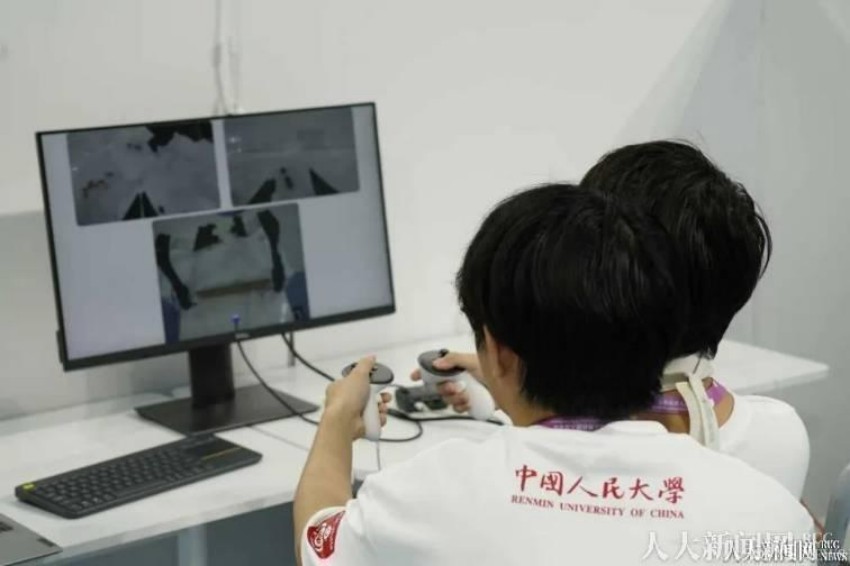
Members of the RUC-HuHa Team train for the competition. [Photo/ruc.edu.cn]
RUC sent two teams to the event: RUC-HuHa and RUC-DIJA. Their impressive performance reflects RUC's leading position in AI applications and offers valuable insights for advancing robotics in medical automation.
"In the future, RUC teams will continue exploring humanoid robots' applications in healthcare, service, and other fields, driving faster technological advancement in intelligent robotics," said Hu Di.