RENMIN UNIVERSITY of CHINA






With support from "Research on Distributed Native Graph Storage and Computing Methods for Graph Learning", a key project of China's National Natural Science Foundation, the team led by Professor Wei Zhewei at Renmin University of China, together with Professor Zhang Yanfeng's team at Northeastern University in Boston, US, has jointly released Jittor Geometric, a graph machine learning library based on the Jittor deep learning framework.
The library is specifically optimized for graph data storage and training, supporting state-of-the-art graph neural network (GNN) models and datasets across multiple cutting-edge areas, providing researchers with a more efficient and forward-looking framework for graph machine learning.
Graph data is increasingly prevalent across many tasks and has become central to research in diverse fields. From user and relationship modeling in social networks, user-item interactions in recommendation systems and protein interactions in bioinformatics, to transaction networks in financial risk control, graph-structured data is indispensable. Graph Neural Networks (GNNs) have emerged as powerful tools for processing such data. Using a message-passing mechanism, GNNs can efficiently learn representations of nodes, edges and their relationships within graph structures, enabling deeper and more nuanced insights. Compared with traditional neural networks, GNNs can directly operate on graph data, enhancing both model understanding and practical performance.
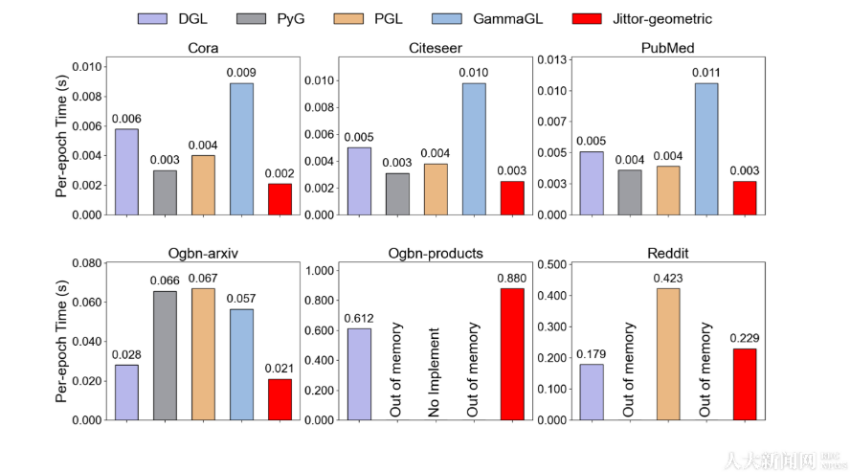
This graphic shows the performance advantages of Jittor Geometric compared with existing graph machine learning libraries. [Photo/ruc.edu.cn]
Built on Jittor, a domestically developed deep learning framework, Jittor Geometric provides researchers and developers with a high-performance, flexible tool for graph machine learning. Jittor employs just-in-time compilation and meta-operator technology, offering efficiency, flexibility and customizability. As the first domestically developed graph machine learning platform supporting the Jittor framework, Jittor Geometric uses these core features to deliver significant performance improvements. In particular, it demonstrates superior computational efficiency and resource utilization for large-scale graph data processing and training, enabling researchers to conduct graph learning tasks more effectively.
Jittor Geometric will continue to be actively maintained, and there are plans to expand support for cutting-edge models, including heterogeneous graphs and graph foundation models, while enriching existing algorithms. The library will also continue optimizing performance for large-scale and distributed training, including efficient task allocation across heterogeneous clusters. In addition, support for domestic hardware will be strengthened to enable larger-scale and distributed training.
Jittor Geometric is an open-source project and welcomes participation and contribution from researchers and developers worldwide.
Open-source: https://github.com/AlgRUC/JittorGeometric