RENMIN UNIVERSITY of CHINA





In the age of artificial intelligence, what is the role of humanity? What is the enduring value of higher education and the humanities? How can we shape a future that harmonizes technological advancement with humanistic ideals? These profound questions set the stage for the inaugural dialogue on "Science, Philosophy and Art: Synergy between Technology and Humanities", held at Renmin University of China (RUC) on September 23.
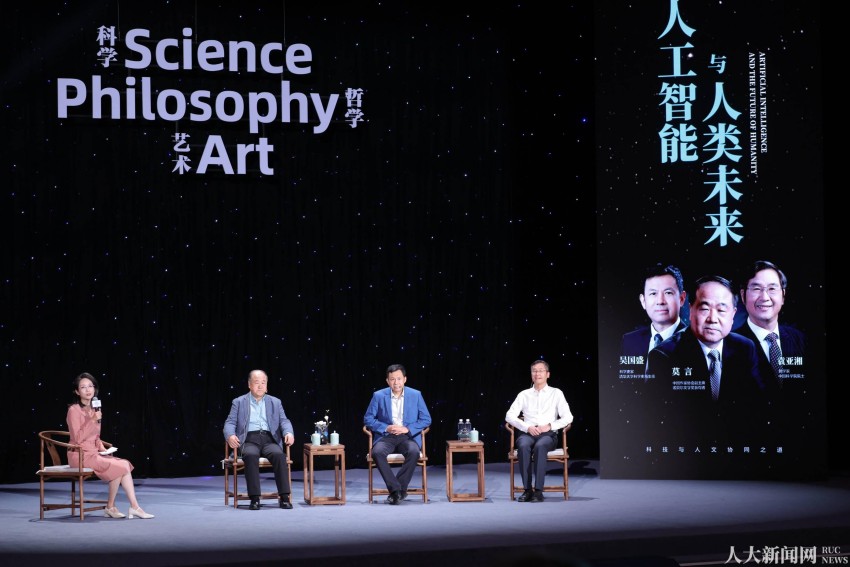
The inaugural dialogue on "Science, Philosophy and Art: Synergy between Technology and Humanities" is held at Renmin University of China on September 23. [Photo/ruc.edu.cn]
The event united three distinguished minds: Mo Yan, a Nobel laureate in literature and renowned writer; Yuan Yaxiang, a mathematician and academician of the Chinese Academy of Sciences; and Wu Guosheng, chair of the Department of the History of Science, Tsinghua University.
They engaged in a thought-provoking discussion with an audience of over 1,000 RUC faculty and students, exploring the implications of AI for humanity's future in a dialogue dedicated to the pursuit of truth, virtue and beauty.
The theme "Will humans be replaced by AI?" prompted insightful reflections. Mo Yan shared his own experiment with AI-assisted writing, noting that while the technology could generate text, the result was often "merely a pile of lavish rhetoric, utterly lacking emotion and thought." He emphasized the irreplaceable role of human creativity, stating, "Originality remains the fundamental driving force for AI's development and progress."
Yuan Yaxiang offered a perspective rooted in logic, suggesting that even the advent of Artificial General Intelligence (AGI) would not surpass collective human wisdom. "AI might outperform humans in specific domains," he acknowledged, "but humanity represents a broad, collective concept. Every AI breakthrough is, at its core, an achievement built upon human intellectual foundations, particularly in mathematics".
Wu Guosheng contextualized contemporary anxieties within the broader history of technology, describing the fear of AI superseding humanity as "a product of fantasy". He observed that technological progress has always been met with a mixture of apprehension and excitement, and each new tool ultimately undergoes societal evaluation and adaptation.
On the ethical and legal challenges posed by AI, the speakers shared a consensus: a deep appreciation for the uniqueness of human civilization is essential. This, they argued, is the key to navigating uncertainty, steering the development of AI responsibly, and moving confidently toward a future where technology and the humanities are synergistically aligned.
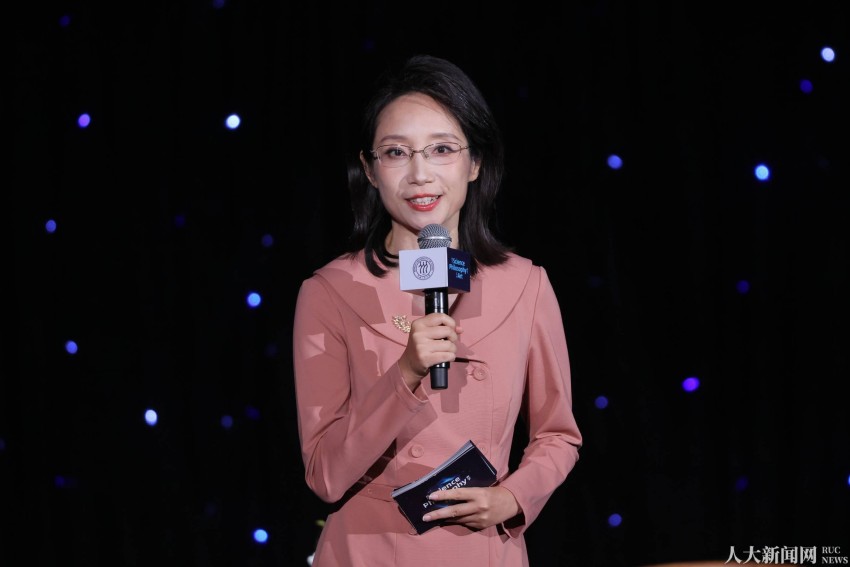
Jiang Ji, a professor of the School of Liberal Arts, RUC, moderates the dialogue. [Photo/ruc.edu.cn]
In response to the pressing question of the humanities' role in a tech-driven era, RUC is championing a path of active integration rather than insular preservation. By fostering cross-disciplinary collaboration within the humanities and between the humanities, sciences, and engineering, the university is implementing an innovative strategy centered on "AI + Humanities and Social Sciences".
Looking ahead, RUC plans to build on this dialogue series to further deepen the integration of science, philosophy, and art. Through continued emphasis on "cross-border integration", the university aims to reinvigorate humanities education, explore sustainable pathways for human-technological collaboration, and contribute to the steady and meaningful progress of human development.
The inaugural dialogue on "Science, Philosophy and Art: Synergy between Technology and Humanities" is held at Renmin University of China on September 23. [Photo/ruc.edu.cn]