RENMIN UNIVERSITY of CHINA





From September 22 to 24, the 2025 Beijing Green Development Forum, themed "Green Beijing, New Journey; Green Economy, New Benchmark" and hosted by the People's Government of Beijing Municipality, was held in Beijing's sub-center, Tongzhou district.
Renmin University of China (RUC) participated as a pioneer in sustainable campus development. President Lin Shangli, Executive Vice-President Zhu Xinkai and Assistant President Li Ming attended the event, with RUC receiving the "Near-Zero Carbon Campus" certification from the China Association of Building Energy Efficiency.
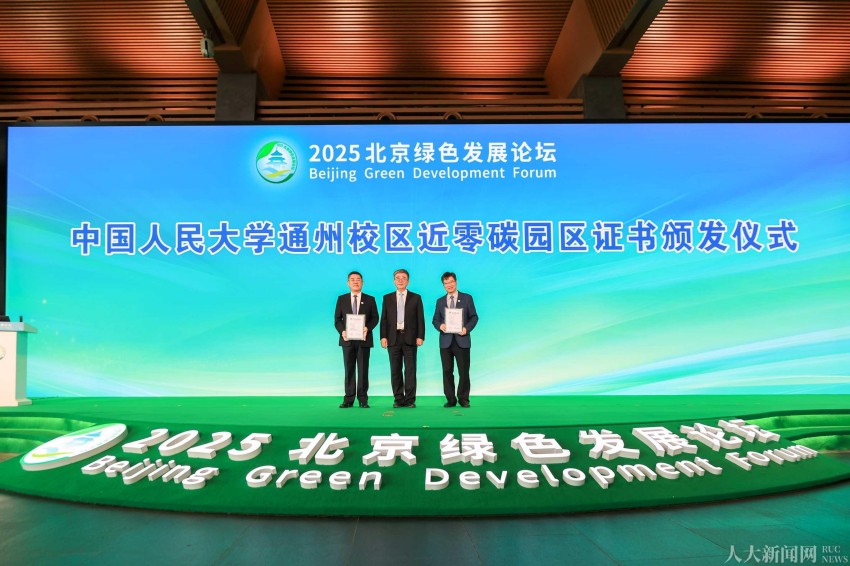
RUC is awarded the "Near-Zero Carbon Campus" certification by the China Association of Building Energy Efficiency. [Photo/ruc.edu.cn]
The Tongzhou Campus reflects RUC's vision of global perspective, international standards, Chinese characteristics, and high-level positioning. Integrating green and low-carbon practices, smart technologies, a people-oriented culture, and student-centered learning, it has become a model of innovation in campus sustainability. In alignment with China's "dual carbon" strategy, RUC partnered with the State Grid Beijing Electric Power Company to develop the nation's first near-zero carbon university campus, setting a global benchmark in green campus construction.
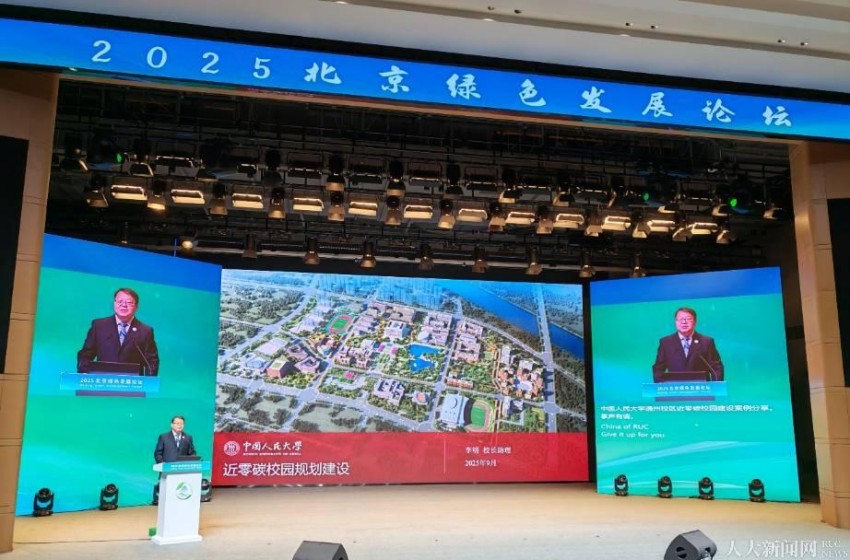
Li Ming, assistant president of Renmin University of China, delivers a keynote speech at the 2025 Beijing Green Development Forum. [Photo/ruc.edu.cn]
Li Ming delivered a keynote speech, sharing RUC's holistic approach across five dimensions — planning, design, equipment selection, intelligent management, and faculty-student participation, which establishes a full life-cycle green and low-carbon campus. Notable achievements include: 100 percent clean energy usage, over 60 percent heating capacity supplied by new energy and renewable sources, carbon emissions reduced to 820 kilograms of CO₂ equivalent per capita per year, and an overall carbon reduction rate exceeding 50 percent.
The Tongzhou Campus stands as a milestone in implementing China's "dual carbon" strategy and provides a replicable model for universities worldwide. It contributes to the coordinated development of the Beijing-Tianjin-Hebei region while delivering environmental, social, and economic benefits. Moving forward, RUC will continue to deepen its green and low-carbon campus development, advancing Beijing's ambition to become a global benchmark city for the green economy, and contributing to global sustainable development.