RENMIN UNIVERSITY of CHINA





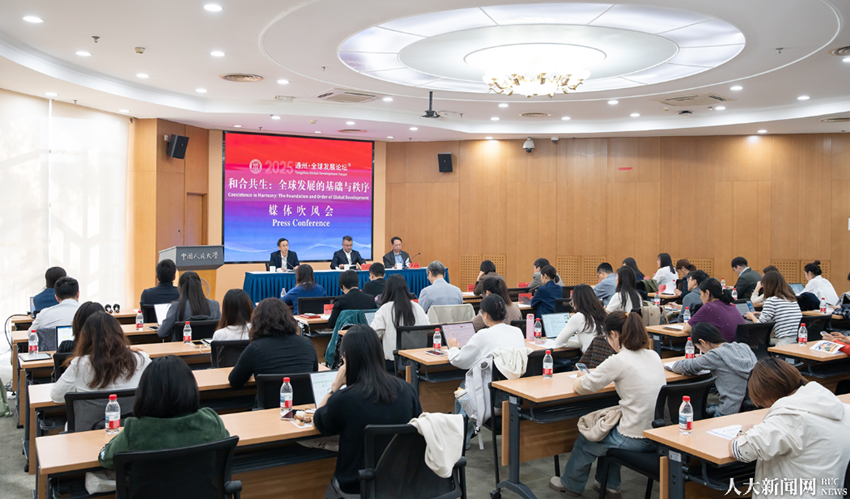
The Tongzhou Global Development Forum, themed “Harmony and Coexistence: Foundations and Order for Global Development,” was held from October 16 to 18. Hundreds of guests from China and abroad gathered in Tongzhou, Beijing, to build international consensus and jointly promote global development.
According to Di Dongsheng, dean of the Institute of Regional and Country Studies at RUC, the forum aimed to explore in depth how to strengthen the foundational trust for global development, build a more just, inclusive, and sustainable international order, and advance harmonious cooperation and win-win outcomes among countries.
More than 500 renowned scholars and representatives of international organizations from countries including the United States, the United Kingdom, and France—along with foreign envoys to China, business representatives, and prominent figures from various sectors—attended the forum.This year’s forum focused on a wide range of topics, including the Belt and Road Initiative, artificial intelligence, global capital market development, digital finance, energy security, food security, sovereign wealth funds, China–Europe development cooperation, global governance, global health, cross-cultural exchange, and youth engagement. The report “Comprehensive Development of Humanity and Society: A Human Development Strategy Toward 2050” was released in seven languages.
Liu Qing, Executive Dean of the National Academy of Development and Strategy at Renmin University of China, presented the forum’s annual report, Comprehensive Development of Humanity and Society: A Human Development Strategy Toward 2050.
He noted that, based on in-depth observations of China’s development experience and global realities, the research team at RUC systematically proposed the concept of Comprehensive Development of Humanity and Society, providing a new strategic framework for global development governance. The report outlines concrete action pathways and policy recommendations for countries worldwide across eight priority areas, including poverty eradication and rural revitalization, as well as food security and agricultural modernization.