RENMIN UNIVERSITY of CHINA





Joel Mokyr, winner of the 2025 Nobel Prize in Economic Sciences, recently visited Renmin University of China (RUC), where he delivered a series of three lectures and was appointed as an adjunct professor.
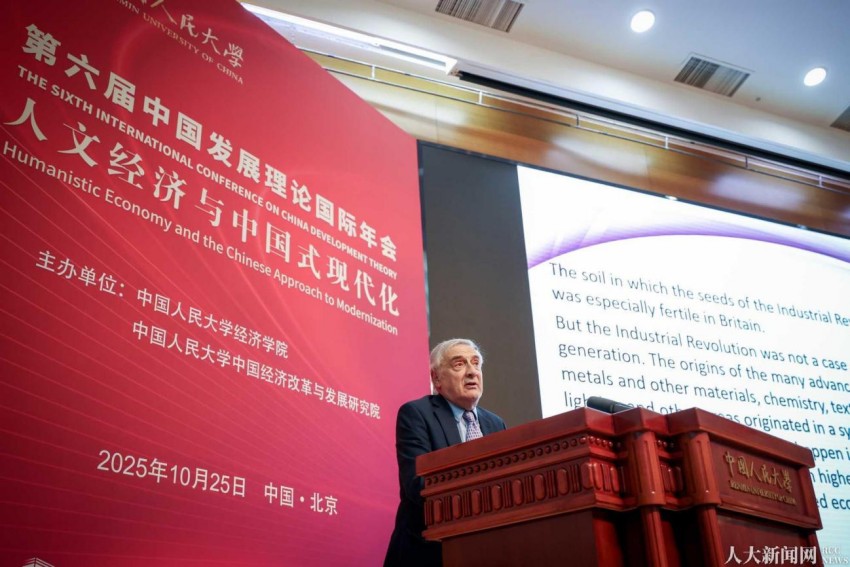
Joel Mokyr, winner of the 2025 Nobel Prize in Economic Sciences, visits Renmin University of China and gives a series of lectures. [Photo/ruc.edu.cn]
On October 13, the Royal Swedish Academy of Sciences announced that economist Joel Mokyr had been awarded the 2025 Nobel Prize in Economic Sciences in recognition of his contributions to the theory of innovation-driven economic growth.
One of the most influential economic historians today, Mokyr has devoted his career to exploring the economic and intellectual roots of Europe's technological progress and the expansion of knowledge. The Chinese edition of his seminal work A Culture of Growth: The Origins of the Modern Economy was published by China Renmin University Press in 2020.
On October 23, Mokyr delivered a lecture at RUC to a packed audience. In his talk, he analyzed the key factors behind the success of the Industrial Revolution, emphasizing that the rise of Britain's elite artisan class was made possible by an effective apprenticeship system and a social environment that encouraged innovation. He noted that the essence of the Industrial Revolution lay in a self-reinforcing positive feedback loop of economic growth, driven by four major forces: innovation, human capital accumulation, the expansion of "useful knowledge" and increasing demand for high-end industrial goods.
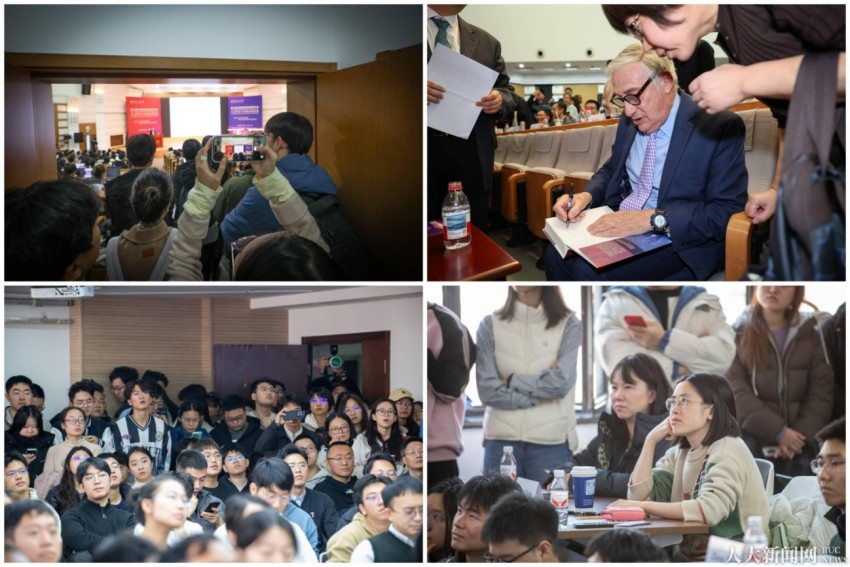
A full house at Renmin University of China as students listen intently to Nobel laureate Joel Mokyr's lectures. [Photo/ruc.edu.cn]
In another lecture themed "Industrial Enlightenment" and its place in global economic history, Mokyr delved deeper into the cultural foundations of this concept. He argued that in 17th-century Britain, the idea of progress became centered on the material improvements brought about by "useful knowledge", rather than on political or social reform. This value orientation motivated individuals through material rewards and social recognition, while professional associations promoted the dissemination of knowledge and fostered a culture of critical inquiry — laying the intellectual groundwork for the Industrial Revolution.
"For the study of economic history, the goal is not merely to recount stories of the past, but to uncover the underlying logic of economic transformation and to seek pathways for today's development," said Liu Shouying, professor at the School of Economics at RUC, who chaired the lecture. "The mutual reinforcement between science guiding technology and technology feeding back into science is vital for national development and social progress. It also provides valuable insights for building a coherent knowledge system in the next wave of industrial transformation."
On October 25, the university held the launch ceremony of the "Nobel Laureate at RUC: A Distinguished Lecture Series". Joel Mokyr was presented with his certificate of appointment as an adjunct professor and received a set of books A New Paradigm for Human Advancement: RUC Series in Civilizational Studies.
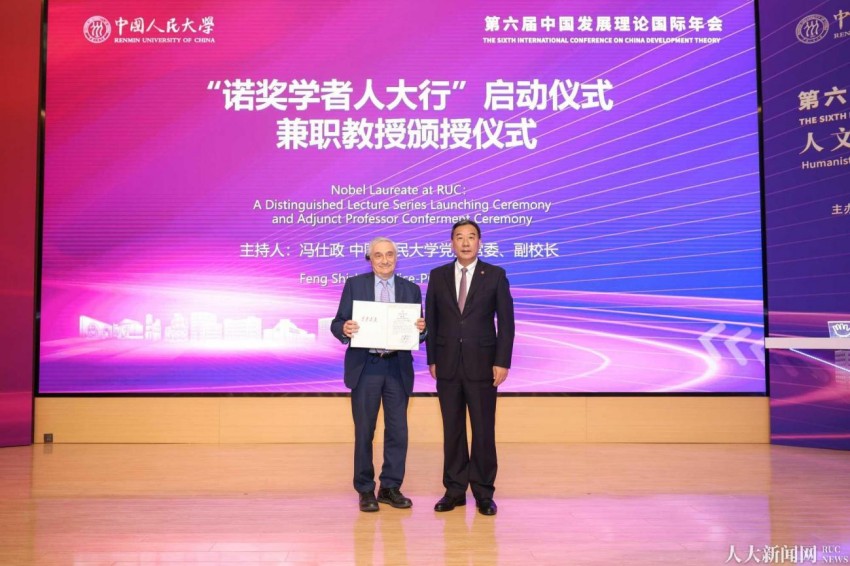
Nobel laureate Joel Mokyr (left) and Zhang Donggang, chair of the University Council, at the launch of the "Nobel Laureate at RUC: A Distinguished Lecture Series" and Adjunct Professor Conferment Ceremony. [Photo/ruc.edu.cn]