RENMIN UNIVERSITY of CHINA





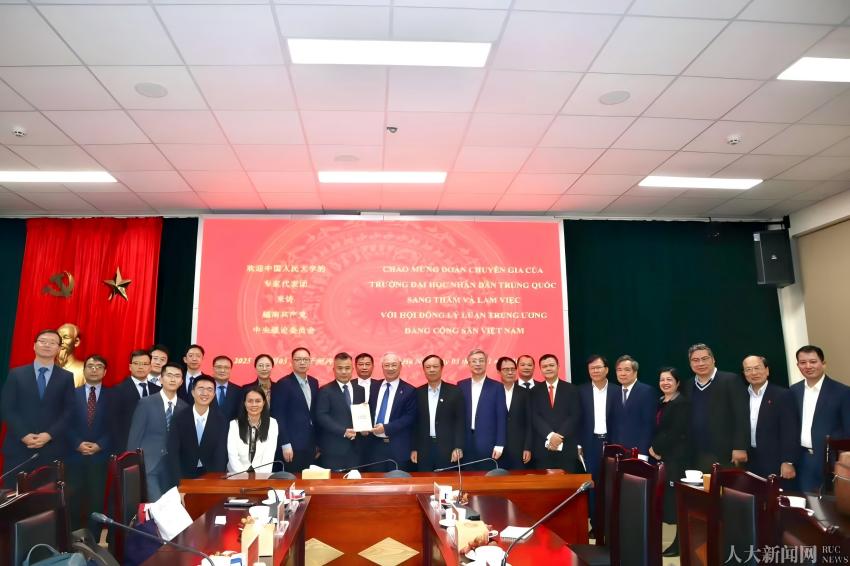
Zheng Xinye, vice-president of Renmin University of China (RUC), led a delegation to Vietnam from November 3 to 7 for enhanced scholar exchanges, research collaboration, talent cultivation, and platform development.
On November 3, the delegation visited the Ho Chi Minh National Academy of Politics and held discussions with the Central Theoretical Council of the Communist Party of Vietnam (CPV). They explored the history and future of socialism, theoretical innovations in Vietnamese socialism, and the advantages of socialism with Chinese characteristics, among other topics. Zheng expressed RUC's willingness to deepen cooperation with the academy in academic research, aiming to promote the localization and modernization of Marxism and explore paths of socialist modernization tailored to national conditions. Nguyen Van Thanh, vice-chairman of the council, emphasized the significance of theoretical dialogue and experience sharing between the two institutions and expressed hope for making more influential theoretical contributions to the global socialist movement.
On November 4, the team visited the Organization Department of the CPV Central Committee to discuss Marxist party building, cadre development, and international anti-corruption efforts. Zheng stated he hoped the visit would enhance research on strategic party-building issues and deepen understanding of governance and development principles. Nguyen Xuan Son, deputy director of the cadre training section of the department, expressed willingness to establish regular exchanges with RUC, including scholar visits, research cooperation, and joint initiatives, to advance educational and research collaboration.
On November 5, Zheng and his team visited the Central Inspection Commission of the CPV to discuss anti-corruption efforts and explore cooperation in personnel training. Zheng highlighted RUC's role in developing a socialist anti-corruption framework. Nghiem Phu Cuong, deputy head of the commission, expressed interest in deeper cooperation with China through scholar exchanges and joint research.
On the same day, they visited the Central Internal Affairs Commission of the CPV to discuss anti-corruption mechanisms, party development, and cadre training. Zheng discussed RUC's commitment to enhancing academic cooperation with Vietnam in disciplinary inspection to support socialist development in both countries. Dang Van Dung, deputy head of the commission, expressed interest in deepening cooperation with RUC through scholar exchanges, joint research, and student training to contribute a socialist perspective to global anti-corruption governance.
On November 6, Zheng and his team visited the University of Social Sciences and Humanities, a member institution of Vietnam National University, Hanoi (VNU). Zheng said he hoped the renewed academic cooperation would aid in planning 2026 projects and enhancing joint research in philosophy, archaeology, politics, and economics. He stressed regular research publications to boost understanding between Chinese and Vietnamese youth. Dang Hong Son, VNU vice-president, highlighted the two universities' strengths in humanities and social sciences and hoped to deepen collaboration for more research achievements.
Zheng also met with Chinese Ambassador to Vietnam He Wei and expressed hopes to deepen collaboration between RUC and Vietnam in education, research, cultural exchange, and talent development, with the embassy's support.
RUC aims to use this visit to strengthen ties with the Vietnamese government, political parties, and universities, focusing on collaborative innovation in party building, economic development, digital transformation, and talent cultivation.