RENMIN UNIVERSITY of CHINA





Recently, the research team led by Associate Professor Zhang Tao at the School of Chemistry and Life Sciences, Renmin University of China (RUC), achieved a significant breakthrough in non-oxidative ethane dehydrogenation for ethylene production. Their findings, titled "SSZ-13 Zeolite with Isolated Co²⁺ Sites as an Efficient and Durable Catalyst System for Non-Oxidative Ethane Dehydrogenation", were published in the top international chemistry journal Angewandte Chemie International Edition. Zhang is the first corresponding author, with RUC as the primary institution.
Ethylene is one of the most widely produced and utilized basic organic chemicals, serving as a key feedstock for plastics, synthetic fibers and fine chemicals. Traditional production processes, however, are often energy-intensive and carbon-emitting. Developing efficient, stable and environmentally friendly methods for ethylene production is therefore critical for promoting a low-carbon transition in the chemical industry. Among these, non-oxidative ethane dehydrogenation using non-precious metal catalysts has emerged as a promising approach.
The team leveraged the unique spatial confinement and stable framework of SSZ-13 zeolite to precisely control the distribution of cobalt species within the zeolite structure.
This research provides new insights for the clean and efficient production of ethylene and other basic chemicals and opens avenues for the application of metal-zeolite confined catalysts in low-carbon hydrocarbon conversion. The work was supported by the National Natural Science Fund.
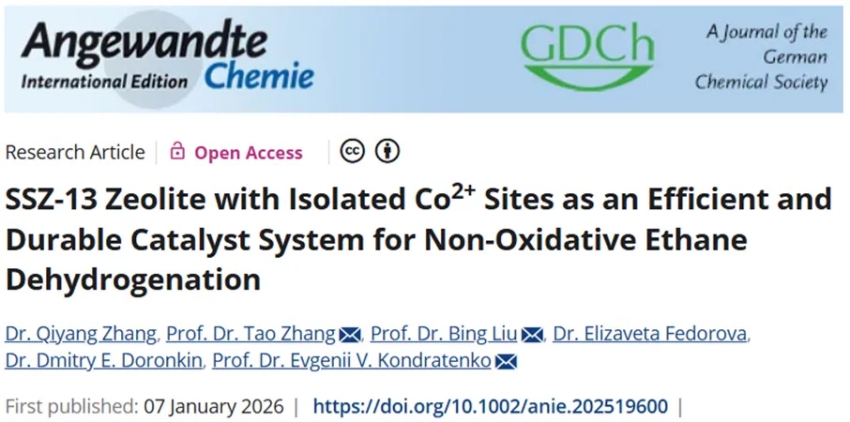
Article: https://onlinelibrary.wiley.com/doi/10.1002/anie.202519600